前言
fetch('https://jsonplaceholder.typicode.com/todos/1')
  .then((response) => response.json())
  .then((json) => console.log(json))
当你直接使用如上的代码来发起网络请求时,你会发现你的 IDE 无法给你提供任何关于 json 的类型提示。
这很合理,没人知道这个接口会返回什么格式的数据。
于是你需要进行如下几个步骤:
- 手动测试这个接口,获取返回值
- 根据返回值的内容,利用如 transform.tools 之类的工具生成对应的类型定义
- 将类型定义复制到你的项目中
- 使用
as来标识返回值的类型
这样下来你也只是能获得接口正常返回时 json 的类型而已,还有很多问题需要被解决:
- 手动请求得到返回值不够准确,比如调用接口出错时,返回值的类型可能会发生变化
- 请求的
url和输入的参数没有任何类型提示 - 当后端接口变动时,tsc 无法给出报错
解决方案的基础
ts 中有个非常好用的功能是 as const 断言,给变量添加这个断言后,变量的类型会被推断为更具体的字面量类型,同时会禁止对变量的修改。
下面是一个简单的例子,可以看到 navigateTo 这个函数的参数变的更加安全了,我们不能传递一个未被定义的路由名称字符串。
const routes = {
  home: '/',
  about: '/about',
} as const

declare function navigateTo(route: keyof typeof routes): void

navigateTo('404')
// Argument of type '"404"' is not assignable to parameter of type '"home" | "about"'.
这就是我们能实现类型安全的 fetch 的基础。
定义路由结构
首先我们需要定义一个路由结构,这个结构包含了一个接口的全部必要信息(请求路径,输入,输入,以及可能出现的错误码)。
同时这里我们使用 zod 来进行运行时的数据格式校验。
// add.ts
import { z } from 'zod'

export const path = '/add' as const

export const input = z.object({
  a: z.number(),
  b: z.number(),
})

export const data = z.object({
  result: z.number(),
})

export const errCode = ['NO_LOGIN'] as const
定义多个接口之后,在 index.ts 中导出所有的接口。
// index.ts
export * as Add from './add'
然后我们就能拿到全部的路由信息
import * as routesWithoutPrefixObj from './interface/index'

const routesWithoutPrefix = Object.values(routesWithoutPrefixObj) as ValueOfObjectArray<
  typeof routesWithoutPrefixObj
>
定义公共类型
定义通用返回结构,公共前缀和未知错误码。 我们并不是接口直接返回数据,而是返回一个包含了错误码和数据的对象。
const routesWithoutPrefix = Object.values(routesWithoutPrefixObj) as ValueOfObjectArray<
  typeof routesWithoutPrefixObj
>

export const prefix = '/api'
export type Prefix = typeof prefix
export const unknownError = 'UNKNOWN_ERROR' as const

export type OutputType<T, Err extends readonly string[]> =
  | {
      err: ArrayToUnion<Err> | typeof unknownError
      data: null
    }
  | {
      err: null
      data: T
    }
计算出带前缀的实际路由
export const routes = routesWithoutPrefix.map((r) => {
  return {
    ...r,
    path: `${prefix}${r.path}`,
  }
}) as unknown as AddPathPrefixForRoutes<typeof routesWithoutPrefix>
转换路由结构
到此为止,我们只是拿到了全部路由对象组成的数组,这对于我们实现类型安全的 fetch 来说并不方便。 我们需要将这个数组转换成一个对象,这个对象的 key 是路由的请求路径,value 是路由的其它信息。 如此,调用 fetch 时,我们就能获得更好的补全体验,在输入确定的路径之后,能得到正确的输入类型和输出类型。
interface RouteItem {
  readonly path: string
  input: z.AnyZodObject
  data: z.AnyZodObject
  errCode: readonly string[]
}

type Helper<T> = T extends RouteItem
  ? Record<
      T['path'],
      {
        input: z.infer<T['input']>
        data: z.infer<T['data']>
        errCode: T['errCode']
        output: OutputType<z.infer<T['data']>, T['errCode']>
      }
    >
  : never

export type DistributedHelper<T> = T extends RouteItem ? Helper<T> : never

export type Route = UnionToIntersection<DistributedHelper<ArrayToUnion<typeof routes>>>
如此我们就能得到最终包含全部路由信息的类型 Route,这个类型的大致结构如下:
type Route = Record<"/api/add", {
    input: {
        a: number;
        b: number;
    };
    data: {
        result: number;
    };
    errCode: readonly ["NO_LOGIN"];
    output: OutputType<{
        result: number;
    }, readonly ["NO_LOGIN"]>;
}> & Record<"/api/dataSet/delDataSet", {
    ...;
}> & ... 13 more ... & Record<...>
为 fetch 添加类型
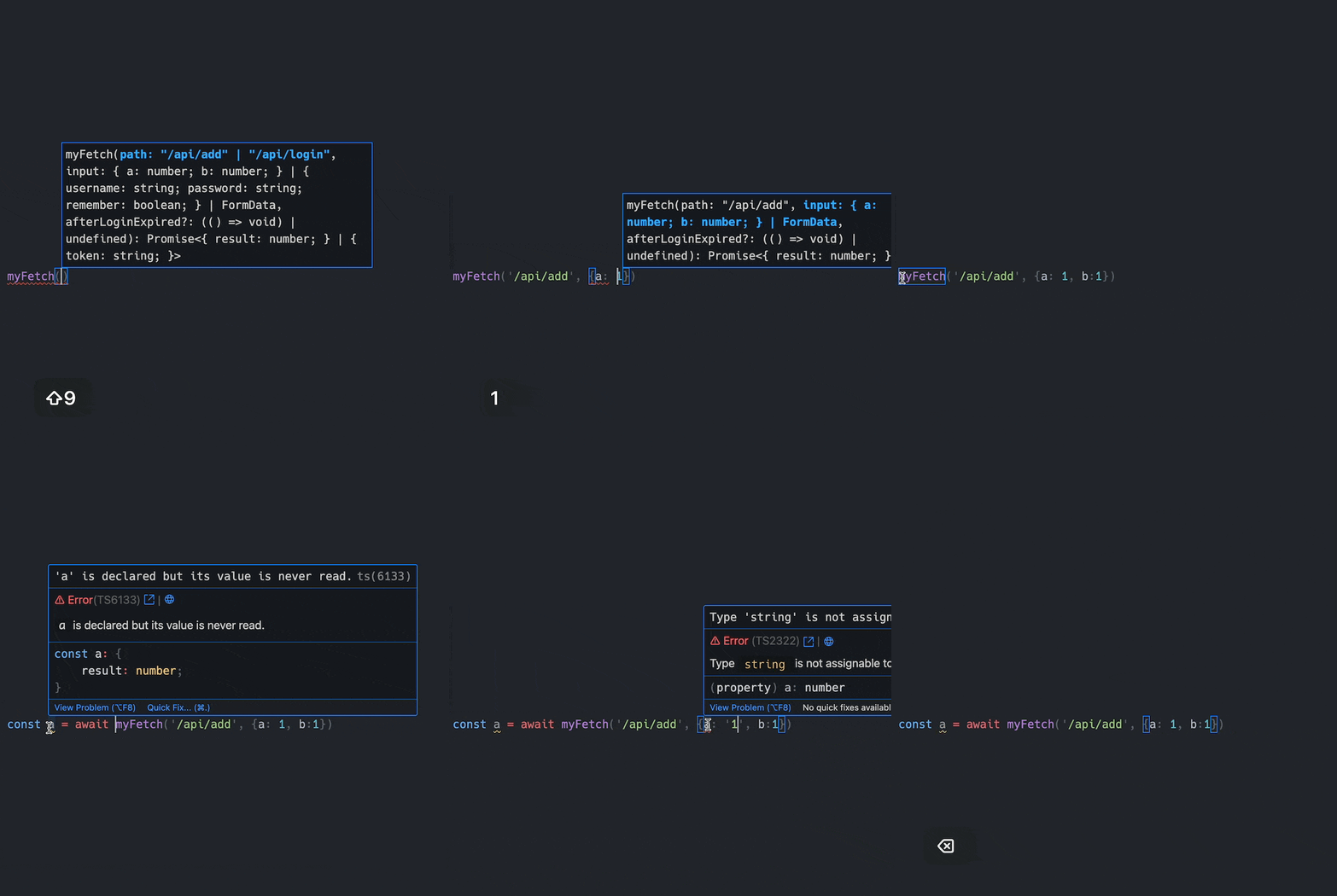
可以看到,只需要约束 fetch 的第一个参数 path 为 keyof Route,第二个参数为对应路由的输入类型,就能得到正确的输出类型。
为了实现上的简单,所有的 http 请求都使用 POST 方法,所有的输入参数都从 body 中传递。
export async function myFetch<Path extends keyof Route>(path: Path, input: Route[Path]['input']) {
  try {
    const res = await fetch(path, {
      method: 'POST',
      headers,
      body: input instanceof FormData ? input : JSON.stringify(input),
    })
    const data = await (res.json() as Promise<Route[Path]['output']>)
    if (data.err) {
      throw new CustomError(data.err)
    }
    return data.data as Route[Path]['data']
  } catch (err) {
    if (err instanceof CustomError) {
      throw err
    }

    if (err instanceof Error) {
      throw new CustomError(err.message)
    }

    throw new CustomError(unknownError)
  }
}

class CustomError<T extends string> extends Error {
  errorCode: T

  constructor(msg: string) {
    super(msg)
    Object.setPrototypeOf(this, CustomError.prototype)
    this.errorCode = msg as T
  }
}
nice,让我们来看看使用效果吧。
最后
文章写到这里就算是结束了,取决你自己的需求,你还可以做如下事情:
- 将它和 useSWR 组合起来,这样你就不必为每个网络接口单独封装函数了
- 在 fetch 中封装更多逻辑,比如自动携带登录所需的 token 和在登录状态过期时自动的路由拦截
- 单独处理非 json 交互的接口,比如文件上传下载
- 说服你的后端,让它用 ts 来给你写接口,这样这些路由定义就不需要你手动写了,也更安全
如果你感谢兴趣,以下是一些被用到但是没有在文章中展开的类型计算。 当然,这份实现未必是最好的,如果你有任何改进的想法,欢迎与我讨论,非常感谢。
export type ValueOfObjectArray<
  T,
  RestKey extends unknown[] = UnionToTuple<keyof T>,
> = RestKey extends []
  ? []
  : RestKey extends [infer First, ...infer Rest]
    ? First extends keyof T
      ? [T[First], ...ValueOfObjectArray<T, Rest>]
      : never
    : never

// https://github.com/type-challenges/type-challenges/issues/2835
type LastUnion<T> =
  UnionToIntersection<T extends any ? (x: T) => any : never> extends (x: infer L) => any ? L : never

type UnionToTuple<T, Last = LastUnion<T>> = [T] extends [never]
  ? []
  : [...UnionToTuple<Exclude<T, Last>>, Last]

type AddPrefix<T, P extends string = ''> = T extends RouteItem
  ? {
      path: `${P}${T['path']}`
      input: T['input']
      data: T['data']
      errCode: T['errCode']
    }
  : never

export type AddPrefixForArray<Arr> = Arr extends readonly []
  ? []
  : Arr extends readonly [infer A, ...infer B]
    ? [AddPrefix<A, Prefix>, ...AddPrefixForArray<B>]
    : never

export type DistributedHelper<T> = T extends RouteItem ? Helper<T> : never

export type ArrayToUnion<T extends readonly any[]> = T[number]

export type UnionToIntersection<U> = (U extends any ? (k: U) => void : never) extends (
  k: infer I,
) => void
  ? I
  : never